Why Does China Export So Many Elevators? Manufacturing Strength and Global Market Demand
November 19, 2026
Why Does China Export So Many Elevators? Manufacturing Strength and Global Market Demand
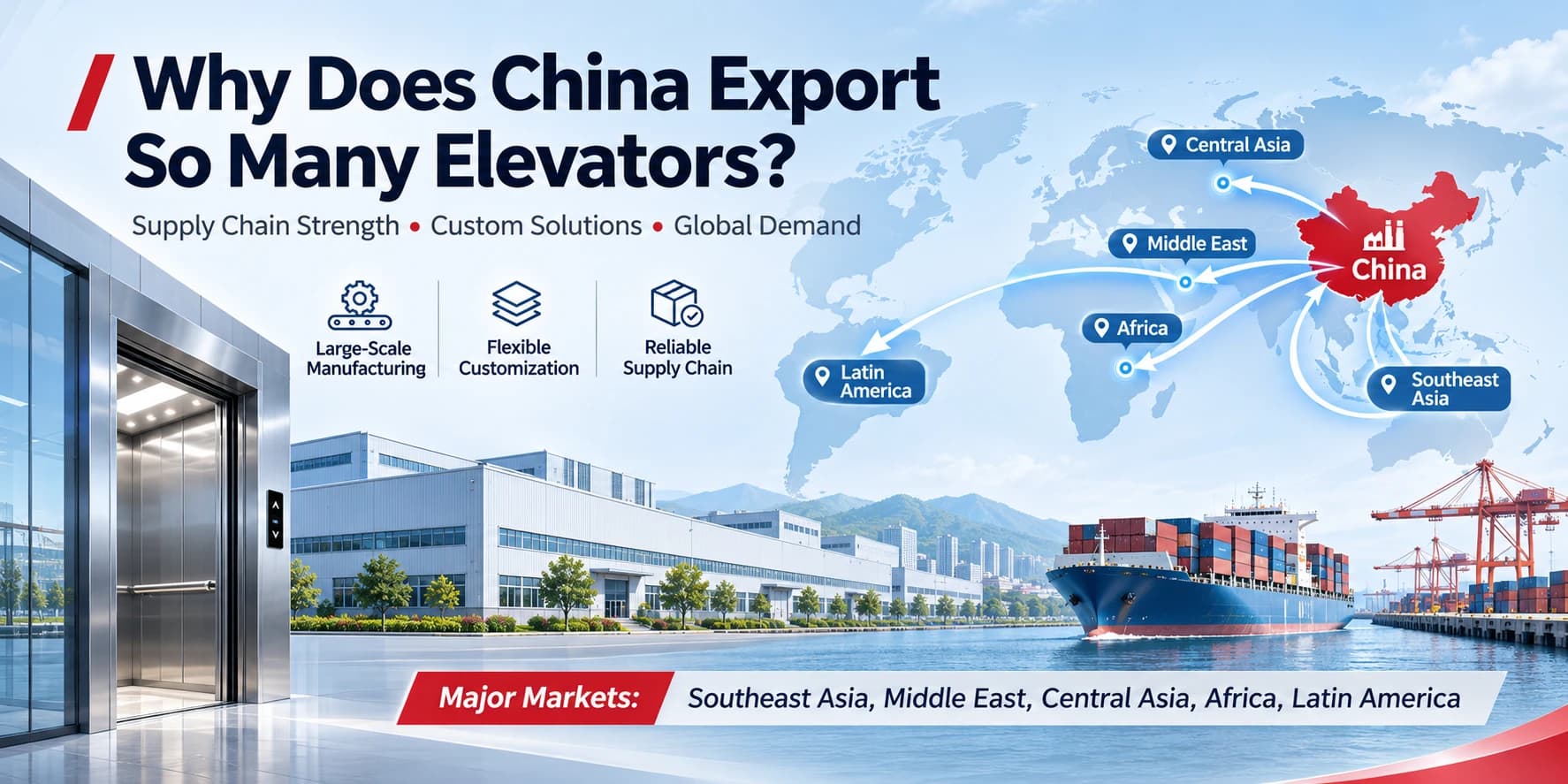
China has become one of the world's major elevator manufacturing and exporting countries. Its competitive position is not based on price alone, but also on a comprehensive supply chain, flexible engineering capabilities and experience serving different building requirements.
From standard passenger elevators to customized installations, Chinese manufacturers can provide solutions for a wide range of international projects.
Why Is China a Major Elevator Manufacturing Hub?
China's rapid urban development and decades of real estate construction created substantial domestic demand for elevator equipment.
This encouraged the development of an extensive manufacturing ecosystem covering traction machines, guide rails, elevator doors, control systems, cabins, safety components and electrical accessories.
Today, manufacturers can source many essential components within China, making engineering coordination, customization and production more efficient.
Another important advantage is flexibility.
Chinese manufacturers can produce standard passenger and freight elevators while also designing non-standard solutions for restricted shafts, unusual building layouts and specialized projects.
For overseas buyers, this means that both complete elevators and customized mechanical or electrical packages can be sourced from an established industrial supply chain.
Where Are Chinese Elevators Mainly Exported?
Chinese elevators are supplied to customers across multiple regions, particularly:
Southeast Asia: Strong demand for residential and commercial building projects.
Middle East: Significant demand for passenger elevators, villa elevators and customized installations.
Central Asia: Growing opportunities in residential construction and infrastructure development.
Africa: Demand for practical elevator solutions across different building types and project budgets.
Latin America: Opportunities for cost-effective complete elevators and replacement equipment.
According to 2025 international trade data, major destinations for Chinese lifts and skip hoists included the United Arab Emirates, Russia, India, Saudi Arabia, Malaysia and Vietnam.
For many importers, purchasing from China offers access to multiple equipment configurations and pricing levels without requiring a complete domestic manufacturing industry.
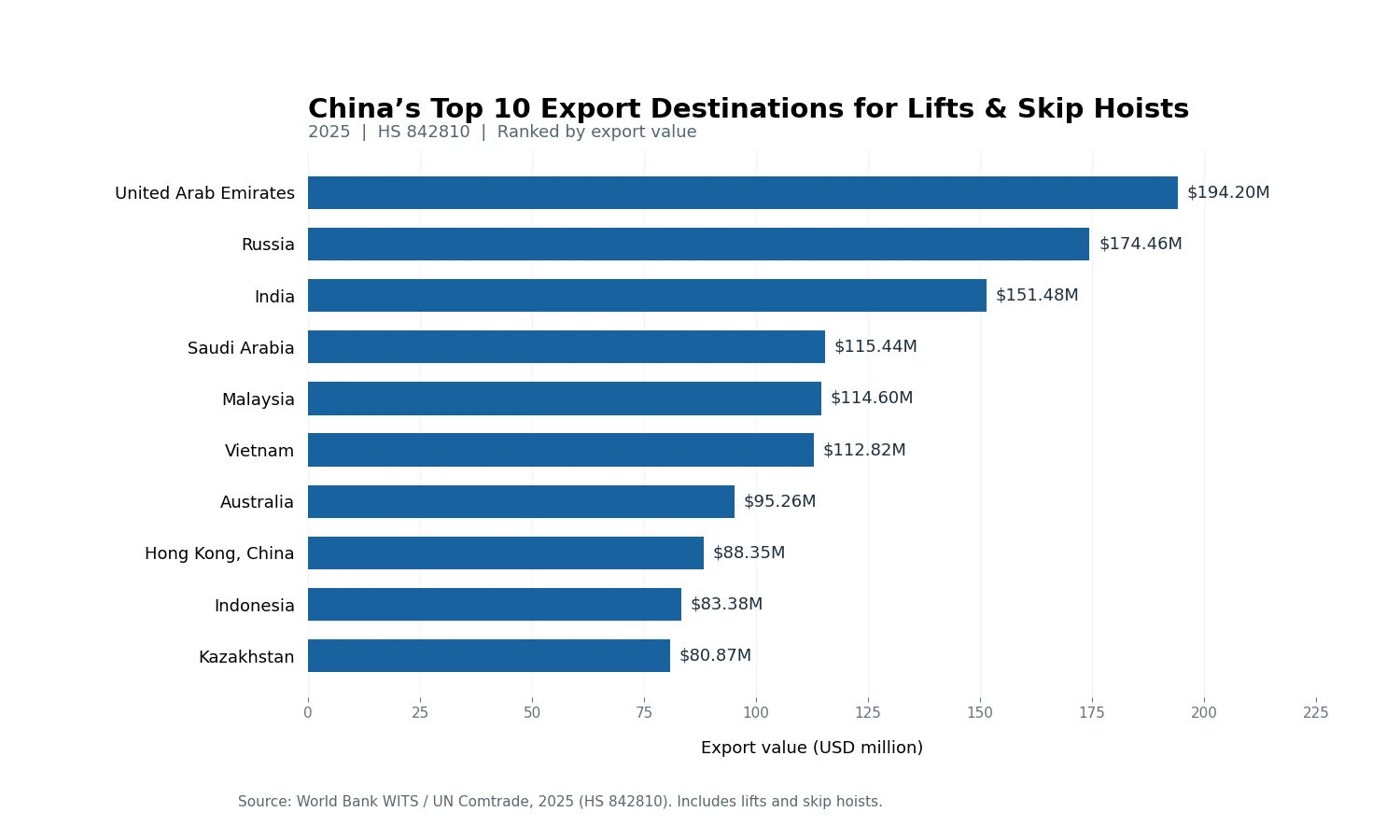
China's Elevator Export Markets: 2025 Trade Data
According to World Bank WITS data based on UN Comtrade, China's exports of lifts and skip hoists (HS Code 842810) reached approximately US$2.46 billion in 2025.
The leading export destinations by value included the United Arab Emirates (US$194.2 million), Russia (US$174.5 million), India (US$151.5 million), Saudi Arabia (US$115.4 million), Malaysia (US$114.6 million) and Vietnam (US$112.8 million).
These figures highlight the geographic diversity of China's elevator export markets, with significant demand across the Middle East, Asia and other international markets.
Source: World Bank WITS / UN Comtrade, 2025, HS 842810. Figures cover lifts and skip hoists and should not be interpreted as passenger elevator shipments alone.
Why Do European and American Markets Import Differently?
Europe and North America have established elevator manufacturers, service networks and regulatory frameworks. Consequently, buyers have more local and regional sourcing options.
European Market
Elevators placed on the EU market must comply with applicable requirements under the Lifts Directive 2014/33/EU, including conformity assessment and CE marking.
For manufacturers, meeting these requirements involves technical documentation, testing, conformity procedures and project-specific engineering considerations.
Chinese suppliers can serve European projects, but not every manufacturer is prepared to undertake the compliance work required for smaller orders.
United States Market
The US market presents different technical and regulatory challenges.
Elevator equipment must meet the requirements adopted by the relevant jurisdiction, commonly involving ASME A17.1 and additional applicable electrical and installation standards.
Differences in equipment configuration, documentation, approval procedures and local installation practices make market entry more demanding.
Therefore, exporting elevator equipment to the United States requires more than competitive manufacturing prices.
Is a Chinese Elevator Suitable for Every Project?
Not necessarily. The correct elevator solution depends on rated load, speed, shaft dimensions, building usage, local regulations and maintenance requirements.
A lower purchase price does not automatically mean a lower lifetime cost.
Buyers should evaluate component quality, spare parts availability, technical documentation, installation support and regulatory compliance before selecting a supplier.
Supporting International Elevator Projects
At Gallop, we support overseas customers with elevator equipment sourcing, mechanical component packages, technical coordination and export shipment arrangements.
For projects involving European or American requirements, equipment selection and compliance documentation must be reviewed according to the specific destination and installation conditions.
China's elevator export strength comes from its ability to combine industrial scale, engineering flexibility and integrated sourcing. For international buyers, the real value lies in selecting the right equipment for the right project—not simply choosing the lowest price.
Gallop's Experience in International Elevator Projects
Gallop supports international elevator procurement projects, including complete elevator equipment and customized mechanical component packages.
Our experience includes coordinating elevator equipment shipments to the United States, covering technical drawing confirmation, manufacturing coordination, export packing and international logistics.
For European and North American projects, we work with customers to review applicable technical requirements, equipment specifications and available compliance documentation before confirming the supply scope.